On any given morning across the globe, headlines paint a vivid picture. Boarders crossed, families fractured, lives interrupted, displaced, and rewritten.
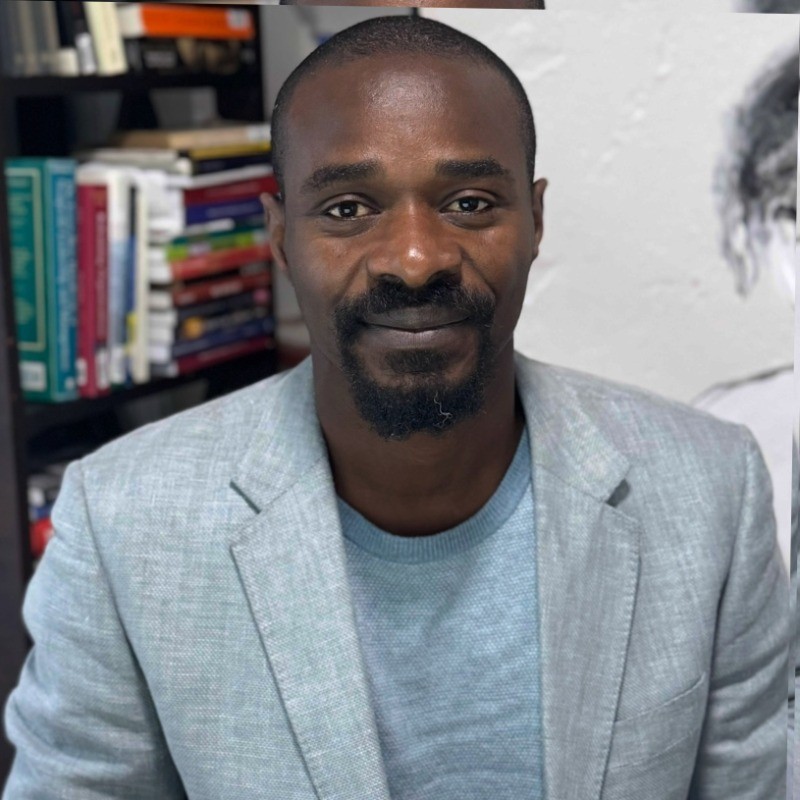
For the average reader, these stories are fleeting. For Moshood Olanrewaju, Ph.D., they are anything but.
“For people to leave their community, there is already a story,” Dr. Olanrewaju said. “When they die, there are more stories — families, expectations, futures that will never come.”
Every loss echoes outward. Every journey carries more than one life.
Nearly three decades ago, during his own journey across borders, Dr. Olanrewaju found himself detained in Dakar, Senegal. Inside that detention Centre, he met stateless migrants whose lives have been interrupted for years. People who no longer knew where they belonged, or even where they could go next.
“They didn’t know themselves anymore,” Dr. Olanrewaju recalled the conditions of the stateless migrants. “There was no way forward, no way back.”
That moment didn’t just stay hidden within him; it defined his life’s work.
Today, as an Adler University faculty member and American Psychological Association representative to the United Nations, Dr. Olanrewaju brings that lived experience to the global stage. He will present at the 19th annual Psychology Day at the United Nations, joining scholars and practitioners from around the world to explore how psychological science can advance human rights in times of uncertainty.
His focus: “Global migration and the protection of human rights: Fostering belonging across borders.”
A world in motion
This year’s Psychology Day theme is “Psychological Contributions to Fostering Collective Action in Uncertain Times.”
From climate displacement to geopolitical conflict, migration is no longer a regional issue. It is a defining global reality that continues to escalate each day.
“We cannot cage migrants,” Dr. Olanrewaju said. “People will move. The question is how do we meet them with humanity when they do?”
Too often, migration is discussed in terms of illegality, policy, economics, or security. Rarely is it centered in something more fundamental like belonging.
For Dr. Olanrewaju, belonging is not tied to geography; it is politically constructed, socially mediated, and unevenly distributed through regimes of citizenship, race and mobility.
“I refuse to Normalise place-based belonging,” Dr. Olanrewaju explained. “I belong to the ecosystem of humanity.”
It is an idea that stretches beyond borders, beyond nationality, even beyond human relationships.
“Even those positioned as my enemy today exist within the same interconnected system that may sustain or save me tomorrow,” he said.
This perspective guides his community psychology work, where ecological, empowerment, prevention and promotion framework are aimed at social progress. Instead of asking how to respond to migration crises after they happen, he asks how do we ensure dignity, safety, and opportunity post-resettlement?
It is a shift from necessary crisis management to human-centered support.
Theory into action
In Chicago alone, Dr. Olanrewaju collaborates with nearly 100 organizations working to support migrant and refugee communities. His work spans policy, education, and direct community engagement.
One initiative he supports as a strategist — the Agent of Hope Training and Information Centers’ Refugee Exit Program (REP) — centers psychosocial accompaniment before arriving in the United States, equipping individuals with cultural orientation, preparedness strategies and empowerment tools that strengthening post-settlement well-being.
“People are often told, ‘just come, you’ll be taken care of,’” Dr. Olanrewaju said. “REP challenges that narratives by restoring agency and preparing people to navigate resettlement as active participants in their own futures.”
His work also challenges persistent misconceptions. A common misconception: migrants take more than they give.
“According to the American Immigration Council, in Illinois alone, migrant communities contribute $180-200 billion to the economy annually through Labour force participation, entrepreneurship, consumer spending and tax contribution,” Dr. Olanrewaju explained. “But myth travels faster than facts.”
That myth is often politically amplified, turning human movement into an alienated narrative rather than a shared reality.
Educating future generations
At its core, psychology offers tools to understand Behaviour, trauma, identity, and connection. At its best, psychology also offers something more powerful: a framework for collective change.
“Psychology invites us to question conditions rather than merely observe them,” Dr. Olanrewaju said. “Not only what is happening, but why these realities exist, and how they can be transformed.”
At Adler, Dr. Olanrewaju carries this work into the classroom, where he challenges students to think critically about power, privilege, and global systems.
His courses don’t just explore theory; they require students to design real-world interventions.
From programs supporting migrant youth to tools that improve safety for marginalized communities, students leave with tangible solutions and a deeper understanding of their role in shaping the future.
“We are losing the art of critical discourse,” Dr. Olanrewaju said. “Yet transformation has always begun where difficult conversations are still allowed to happen. That’s where growth happens. That’s where change begins.”
In one of his Favourite courses, Social Determinants of Mental Health, the learning doesn’t end in discussion, but it becomes creation.
By the end of the class, students are asked to design a real-world intervention: a program or policy intervention that addresses a social issue impacting mental health.
One student designed a visual indicator for deaf drivers to place at the back of their vehicles, helping police officers understand their communication needs before an interaction escalates.
“It’s small,” Dr. Olanrewaju explained. “But it saves lives.”
Other students have developed programs to support unhoused individuals, underemployed migrants, and proposed state-level policy for students in active military duties. All these intervention shape mental health long before someone enters a Counselling space.
For many, it’s the first time they see themselves not just as future practitioners, but as changemakers.
Moving forward
Despite the complexity of the work, and the emotional weight it carries, Dr. Olanrewaju remains grounded in hope. Not because the challenges are small, but because the commitment of people is immense.
“Some of my colleagues are doing this work with no resources, no recognition,” Dr Olanrewaju said. “They just keep going.”
That quiet persistence, he believes, is what will ultimately drive change.
As Psychology Day at the United Nations approaches, Olanrewaju’s message is simple: belonging is not a privilege. It centers on human needs.
In a world where borders continue to shape lives, psychology has a critical role to play, not just in understanding that need, but in helping societies meet it.
Behind every statistic is a story, and behind every story is a person still searching for a place to belong.
“There is more that connects us than divides us,” Dr. Olanrewaju said. “We just have to be willing to see it.”