Originally from a small town in Nebraska, first-year Doctor of Psychology in Clinical Psychology student Autumn Hanson took her undergraduate research from the University of Nebraska-Lincoln to Adler University in Chicago.
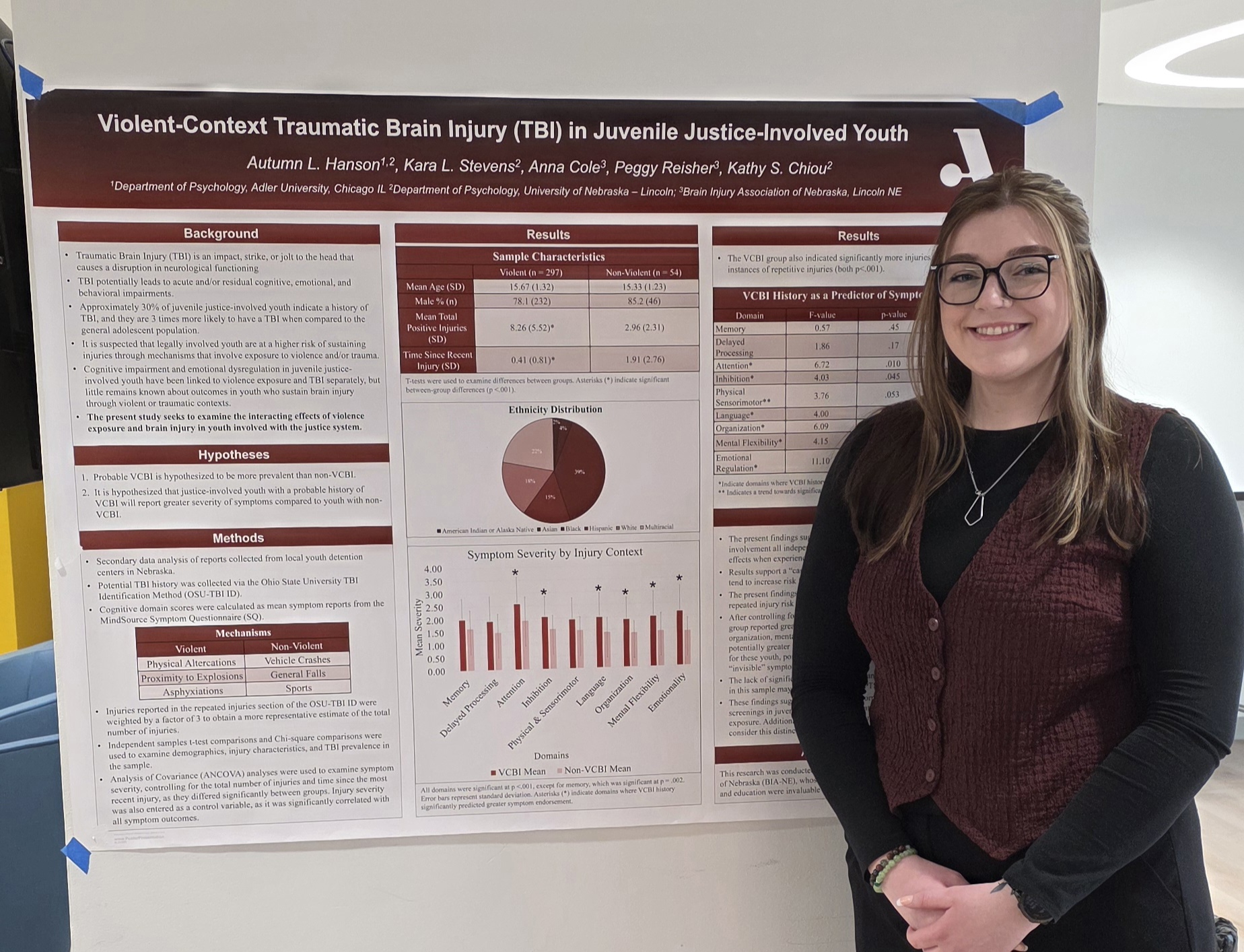
Hanson presented her neuropsychology-based research at the 13th annual Association of Chicagoland Externship and Practicum Training (ACEPT) Conference at National Louis University on May 1, where she placed third overall.
ACEPT is an organization aimed at improving the structure and ethical standards of the practicum process for graduate psychology students.
“It’s important to have that research poster presentation experience, but it’s also a great networking opportunity to connect with other students, other schools, and other mentors and professors,” Hanson said. “Being a first-year student at Adler, I thought this would be a great way for me to get immersed in the psychology community.”
From undergraduate research to publication
Hanson’s research began while she was an undergraduate psychology student at the University of Nebraska-Lincoln. While thinking about her honors thesis, Hanson wanted to use her work in the neuroscience and neuropsychology lab. Hanson and her mentor started looking at violent context traumatic brain injury in the juvenile justice-involved youth population.
“There are very few articles that look at both trauma and violent context in the same individual in the same population,” Hanson explained.
When a child came through one of the two county centers in urban Nebraska that Hanson was using for research data, they were given a traumatic brain injury screener, resulting in a 400-participant data set. From there, Hanson worked on a small thesis based on the research.
After graduation, Hanson, her mentor, and another student from the same lab continued refining the research with the goal of publication. At the ACEPT conference, Hanson presented an early portion of the project while the larger study continues through the publication process.
Building a future in neuropsychology and service
Hanson interviewed at many graduate school programs before enrolling at Adler.
“Adler was the only place I interviewed that felt very diverse and inviting,” Hanson said. “The Chicago community is a great place to learn and reach new opportunities, and Adler itself has lots of in-house opportunities to learn from peers and professors.”
In addition to her studies, Hanson has served as a military reservist for the past five years and hopes to apply for the Health Professions Scholarship Program during her time at Adler.
Her long-term career goals range from serving as an active-duty military clinical psychologist to becoming a clinical neuropsychologist specializing in dementias. Her goals are deeply personal.
“My mother-in-law passed away from Alzheimer’s, and I noticed when my husband was going through that process with his mom, there wasn’t any guidance offered to the family,” Hanson said. “They didn’t tell my husband what to expect. I want to be the individual who helps provide support for the families during moments like these.”
Hanson hopes to return to Nebraska one day and work with rural populations, offering guidance and support as a neuropsychologist, which she notes is uncommon in rural settings.
Whether working in military settings, hospitals, or rural communities back home in Nebraska, Hanson hopes her career will combine research, clinical care, and compassionate support for underserved populations. For her, psychology is not only about understanding the brain, but it is also about helping people navigate some of life’s most difficult moments with clarity, care, and connection.