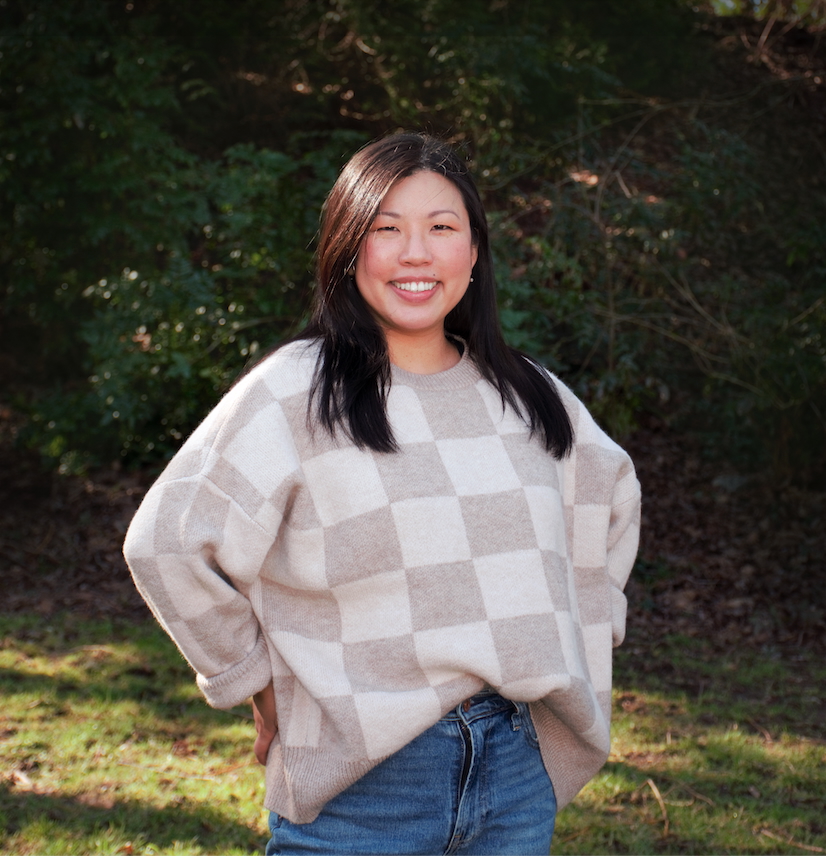
For Esther Jaang, MA’25, spirituality has been an essential part of her life, and one that has continued to evolve.
“It has always been foundational, but perhaps in previous years, my experience of spirituality was weighed down with a lot of definitions that no longer resonate with me,” she said. “Today, I would define spirituality as an experience of the divine or the sacred. That’s my short answer to a big question.”
The longer explanation can be found in her thesis, “Everything is Everything: Exploring the Relationship Between Developmental Trauma Healing and Spirituality,” which she completed as a student in the Master of Arts in Counselling Psychology at Adler University in Vancouver.
“In my own journey, I have come to experience spirituality as a very real aspect of existence,” she said. “And depending on my state of consciousness in a given moment — such as when I am in a deeply meditative state — the nonphysical ‘spirituality’ feels as real as the physical.”
For her thesis, Jaang said she wanted to explore whether others had similar or varying experiences.
Choosing a topic was easy. For Jaang, the challenges and overcoming them came much later.
“Fulfilling this thesis was one of the hardest things I’ve ever accomplished,” Jaang said. “Granted, I got pregnant and gave birth to a beautiful baby while working on it. But in addition to the life changes, I experienced delays that I couldn’t anticipate because I had never done academic research before.”
“It took tremendous effort and intentionality,” Jaang added. “But I was able to show myself a new way of being and working and learned more than I thought I was capable of.”
Jaang’s thesis explored how healing from ongoing childhood or developmental trauma might affect one’s experience of spirituality and vice versa. Jaang collected qualitative data through semi-structured interviews with four trauma counsellors, all of whom have had personal and professional experience on the topic.
She found an immense diversity in individual spiritual experiences, several key themes in the processes of developmental trauma healing, the significance of spirituality in the healing journey, that healing can serve as a pathway to spiritual expansion, and that spirituality can be experienced as indivisible from healing.
Today, Jaang recently started her own private practice, Greater Web Counselling. The name stems from a model that emerged from her thesis: “Greater Web” is a concept of Oneness that can feel both supportive to and synonymous with healing. Below, she reflects on her thesis experience and what she enjoyed most during the process. She also shares five pieces of insightful advice for students embarking on their own thesis journey.
Why did you choose to do the Master of Arts in Counselling Psychology program with the thesis option? (A non-thesis option is available in the Master of Counseling Psychology program.)
I wanted to pursue a Ph.D. later in life, and I knew a master’s thesis could help open those doors. I also love conceptualizing, and I enjoy writing. I had a hunch that I would really enjoy the thesis process.
How did you choose your thesis topic?
I chose it based on my lived experiences. I came into the master’s program with a general idea of what I wanted my thesis to be about. Thankfully, I found a supervisor who wanted to work with me on this topic, and whose research background aligns with the methodology I wanted to use (grounded theory).
For current students who are now deciding on their thesis topic, I encourage them to ask these two reflection questions:
- What do you wish more people in the world, either the world at large or the world of counselling, knew more about?
- What is an experience that you, a loved one, or a group you care about, has had that you wish to learn more about?
Finding a topic that is personally meaningful can help make it easier to ride through all the waves that come as part of this process. At least, this was the case for me.
What did you enjoy most about working on your thesis?
I enjoyed almost every part of the research and writing process. I felt flow states while researching, archiving references, interviewing participants, analyzing the data, theorizing, expressing my ideas in an academic format. Even the moments of stuck-ness that I encountered felt exciting to me. Having my own domain, a sphere of expression, exploration, and influence felt great. The work felt creative, and the interview data, which I knew intimately by the end of the process, catalyzed much growth and healing for me.
What did you find most challenging, and how did you address it?
A big part of the struggle was that I could not read my thesis timeline accurately.
But honestly, I think the delays were just part of the process that I had to learn to accept. Revisions and re-writing take time. They’re not always about whether the writing is good or not…it’s also about the clarity and fit of the conceptualization.
Do you have any advice for other master’s students who may be starting or are underway in their thesis journey?
Yes. My thesis journey wasn’t only about research and writing. It touched every part of my life, from finances and time management, to patience and support. For students beginning this process, here are five things I wish I knew back then:
- Be mindful of student loan planning. If you’re using loans to support your studies, talk early with the school’s financial adviser. After a certain number of terms, you may need to register for “thesis continuation,” which could affect your full-time loan status. If your thesis takes longer than expected, it’s important to understand how that might impact your funding.
- You’ll have idle time. I thought I could power straight through once my courses were done, but research has its own rhythm. There are natural pauses while waiting for feedback, approvals, or participant responses, and those gaps are part of the process.
- It can take longer to start counselling professionally. When choosing to do a thesis, you can’t practice on your own without a supervisor, even if you’re done courses, the practica and the MCQE.
- Plan for extra expenses. There are added costs in addition to tuition in order to complete the thesis. For example, students are required to hire an APA editor, and the cost will depend on the length. My thesis was around 300 pages, and it was $1,500 USD for APA editing.
- Seek out social support regularly.
Working on a thesis can often be a very lonely process. We work at our own pace, on our own topics, with our own advisors, so it can be hard to find others with shared experiences. I can’t over-state this enough, one of the hardest parts of doing a thesis for me, was that it can feel very isolating. So, it is very important to invite others into your process. Find people in your life that you can regularly vent to, brainstorm ideas with, and celebrate small wins and milestones with. Outside of my thesis committee, my biggest supports were my husband, my cats, two friends, my therapist, the Thesis Coordinator at Adler University, YouTubers who shared thesis/dissertation journeys that I resonated with, and transient relationships/passers-by whose names I may never have received, but who would encourage me with a “good for you!” when I’d share what I was working on. ALL of these relationships mattered and helped me maintain resilience.
Anything else you’d like to add about your thesis experience?
I am very glad I did a thesis. I learned so much about myself, about my topic, and was able to support other counsellors who have also been exploring the topic of trauma healing and spirituality.
I am not exactly sure what will unfold next, but I do know that I want to continue developing the models that emerged from this study, and I want to support other counsellors who are seeking to integrate spirituality as part of their clinical practice and/or healing journeys. Whether or not you choose to weave a thesis project into your master’s program, I wish you the best of luck, and I hope you enjoy your time at Adler. If you want to connect about anything, feel free to reach out to me at connect@greaterweb.ca.