
When Benjamin D. Aiken, Ph.D., boarded a series of planes, ships, and ferries bound for the remote Pitcairn Islands in April 2023, he thought he was chasing an adventure.
A dot of volcanic rock in the middle of the South Pacific, Pitcairn is isolation in its purest form.
“There’s no commercial way to get there,” he said. “Other than a supply ship that comes by three or four times a year, there’s no way to get off this island.”
What he found instead was a meditation on loss, connection, and meaning — one that would eventually become the foundation for his essay, “On a Bounty of Meaning: A Logotherapeutic Memoir of Pitcairn,” published in the spring issue of The International Forum for Logotherapy.
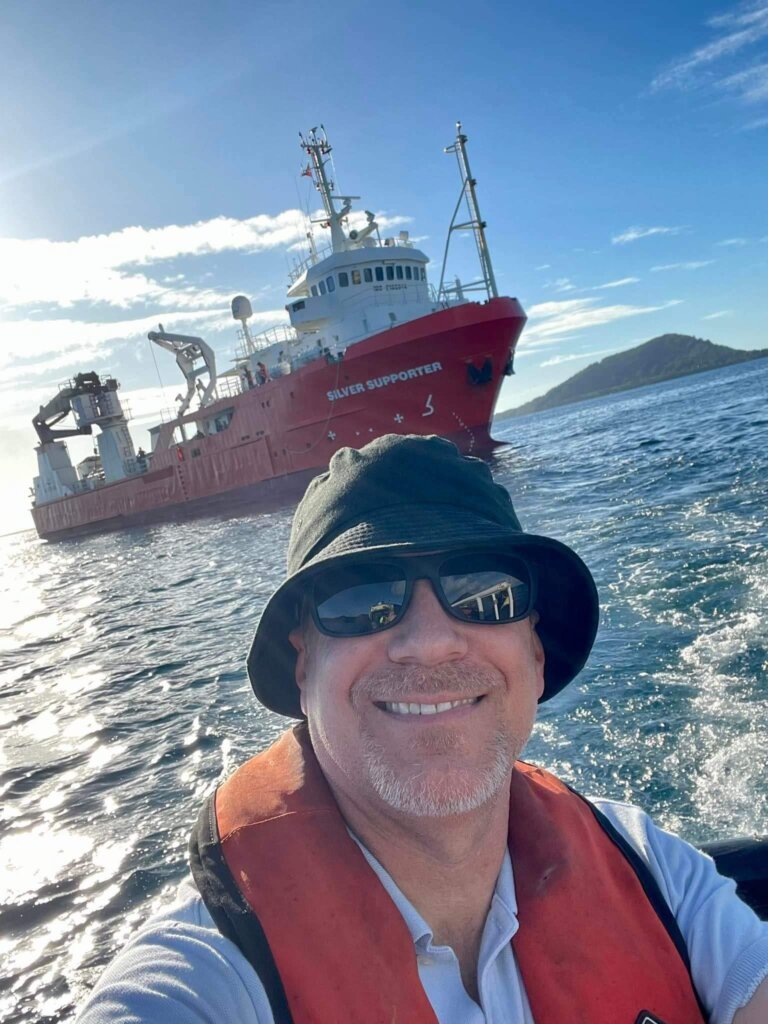
It took Dr. Aiken — an Adler University faculty member and an avid traveler who’s visited more than 100 countries — nearly a week to reach Pitcairn, the world’s least accessible inhabited island. At the island’s rugged outcrop known as Christian’s Cave, where Mutiny on the Bounty leader Fletcher Christian once hid, he confronted the solitude head-on.
“That realization of isolation grounded me in the philosophy of Viktor Frankl — and in some ways Alfred Adler — on the meaning of connection and community,” he said.

It took Adler University faculty Benjamin D. Aiken, Ph.D., nearly a week to reach Pitcairn Islands, the world’s least accessible inhabited island.
Turning isolation into insight
For Dr. Aiken, the trip wasn’t just a test of endurance. It was a pilgrimage. His late partner had long dreamed of visiting Pitcairn but never had the chance.
“It was really his idea initially,” Dr. Aiken said. “In some ways, it was a posthumous journey we took together.”
What began as travel became reflection.
As a counselor, educator, and logotherapist, Dr. Aiken recognized echoes of Frankl’s Logotherapy in his own experience — the idea that meaning is found not in avoiding hardship, but in how one responds to it.
“I kept journals throughout the trip,” he said. “When I revisited them later, I began to see patterns and threads, with purpose and meaning woven through the smallest moments, including meeting the locals who make Pitcairn their home. That became the foundation for the essay and memoir.”
In “On a Bounty of Meaning,” Dr. Aiken blends the intimacy of travel writing with the depth of psychotherapy theory. The result is a portrait of what it means to search for belonging in a place defined by remoteness, and to discover that connection is as much an internal act as an external one.
A living theory
Back in his classroom at Adler University in Vancouver, Dr. Aiken often draws on his experiences to show students that theory isn’t just something lived, not just studied.
“I want my students to understand that a theory of therapy is also a worldview,” he said. “We each see the world differently, and theory gives us a structure for exploring that. My hope is that this story helps others bring meaning into their own here-and-now experiences.”
For him, his essay connects two of psychology’s great humanists: Alfred Adler and Viktor Frankl.
Although his essay largely focused on Frankl’s philosophies, Dr. Aiken said he’s able to bridge the two thinkers.
“Frankl was a student of Adler’s,” Dr. Aiken said. “Adler emphasized our search for connectedness; Frankl extended that to a search for meaning.”
“You can be among a thousand people and feel alone,” he added. “But one meaningful connection restores that sense of community Adler described.”
As for Pitcairn, Dr. Aiken hasn’t ruled out going back, possibly next time with students.
“Maybe we’ll organize a group trip there one day,” he said with a smile. “Though I might warn everyone that it’s a long way to find yourself.”