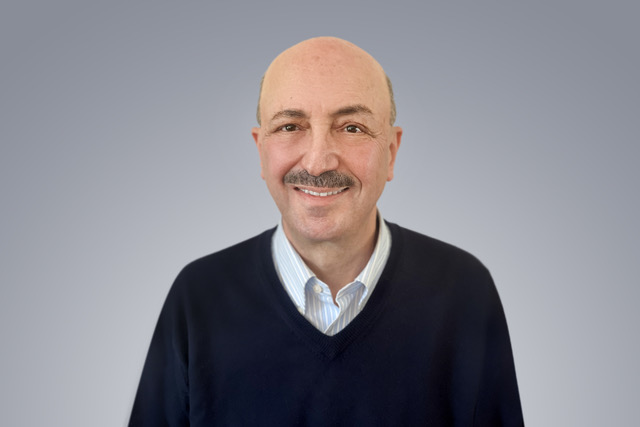
Jay Colker ’80, D.M., may have officially “retired” in 2017, but his work and his passion for teaching have not slowed down.
Nearly a decade later, Dr. Colker remains deeply engaged at Adler University, serving as an industrial and organizational psychology faculty member — still in the classroom, still mentoring students, still driven by the same purpose that has guided him from the start: helping people function better in families, workplaces, and communities. For Dr. Colker, retirement changed his title, not his mission.
Dr. Colker always knew he wanted a career centered on people. After earning his bachelor’s degree in psychology from Penn State University in 1973, he found himself drawn to roles that emphasized connection, education, and real-world problem solving. Those early experiences working with families, students, and individuals navigating serious mental health challenges laid the foundation for what would become a lifelong dedication to teaching and mentorship.
That commitment deepened in Washington, D.C., where Dr. Colker lived with his cousin Janet Terner, who was deeply involved in the Adlerian scene. There, he was immersed in Adlerian psychology through the Family Education Center of Greater Washington, learning and later practicing open forum family counseling, an Adlerian model that treats learning as a shared, community-based experience.
Under the mentorship of Adlerian leaders such as Manford Sonstegard, an expert in Adlerian group counseling, Dr. Colker saw firsthand the power of education as a living, participatory process — one that extends beyond theory into everyday life into everyday life.
“Stonstegard drove up every other weekend from West Virginia to Washington, D.C., for two years without any pay so that he could train us in open forum family counseling,” Dr. Colker said.
Dr. Colker carried those values to what was then the Alfred Adler Institute in Chicago, now Adler University, where he was part of the institute’s first degree-granting cohort. Earning his Master of Arts in Counseling Psychology, he studied alongside foundational Adlerian figures, an experience that reinforced what had already become clear to Dr. Colker: teaching had become central to his identity.
While furthering his career and earning more degrees, Dr. Colker stayed true to the students and the university that was important to him. Dr. Colker has seen Adler through many iterations, stemming all the way back to the founders who helped shape Adler into what it is today.
“I studied with all the major people that were colleagues of Dreikurs, learned from them, and took classes from them — Adler founders Harold Mosak and Bernard Shulman; Bob Powers, among others. I became very close with one of Dreikurs colleagues, Bernice Bronia Grunwald, who became a mentor to me,” Dr. Colker said.
That clarity followed him back to Adler in the 1990s, when he took over family counseling courses from Grunwald herself, continuing a tradition that sits at the heart of an Adler education: passing down a collaborative, experiential model from one generation of scholars to the next.
“I taught my students the open forum family counseling, just like I had learned years ago in D.C. It’s a privilege to now be able to teach this Adlerian practice to the next generation of Adler scholars,” Dr. Colker said.
In 2014, he partnered with colleagues and the Center for Adlerian Practice and Scholarship to create AdlerPedia, a free, open-access platform that offers a growing collection of articles, videos, and other materials focused on Adlerian theory and practice.
Recently Dr. Colker led a consulting skill building workshop for current students applying learning to real-world scenarios through a discussion with Jason Ray, the founder of the Wisconsin LGBT Chamber of Commerce. The workshop explored challenges faced by the chamber, including staff motivation, organizational resilience, and the need to balance revenue generation with effective team management.
Today Dr. Colker’s classroom remains an extension of his values — as does his consulting practice focused on optimizing leadership, learning and development, and recently authored book. Across all of it, his work reflects a belief in education as a tool for empowerment, one that connects theory to practice and learning to real human experience.
“I have a value system that I have — give it away to keep it. What I mean by that is that if any student needs help or for me to answer a question, they can reach out,” Dr. Colker said. “I continue to offer support where I can. Supporting students and even graduates along the way is still a life mission for me.”