
Before she ever moved to the Arctic or imagined opening a clinic of her own, Stephanie Leithead, MA ’11, was trying to understand what kind of counsellor she wanted to become.
During her graduate training in counselling psychology at Adler University in Vancouver, she was drawn to work that centered people’s lived experiences and created space for care that felt grounded, compassionate, and accessible. Her courses and clinical training at Adler emphasized themes that would become foundational in her own practice, including community engagement and accessible care.
Leithead carried those values with her as she entered the field, unsure of where they would lead but certain she wanted her work to have a deeper purpose.
In her early roles as a family and child therapist, that feeling only grew stronger. Leithead wanted to be closer to communities where support was harder to find and where connection mattered as much as clinical skill. She didn’t yet know that this instinct would reshape her understanding of practice and eventually lead her to build a new model of care in the North. She only knew she was ready for something different.
That clarity set the stage for a choice she hadn’t anticipated. And in 2013, she made the decision that changed everything.
Northbound
After several years working as a family and child therapist in Vancouver, Leithead began exploring opportunities across Canada and abroad — from major cities to remote northern communities. One of the positions that surfaced was in Paulatuk, a small community in the Northwest Territories.
“I thought, ‘It’s too small, too remote,” said Leithead. “But I did the interview, and at the end of it, they offered me the job, and I just said yes.”
That unexpected yes sent Leithead north to Paulatuk for a two-year counselling contract. The transition presented unique hurdles: cultural adaptation, lack of resources, and the emotional weight of supporting communities still healing from the legacy of residential schools.
Leithead drew on the frameworks of Adler’s teaching of serving underserved communities to navigate this new step in her career.
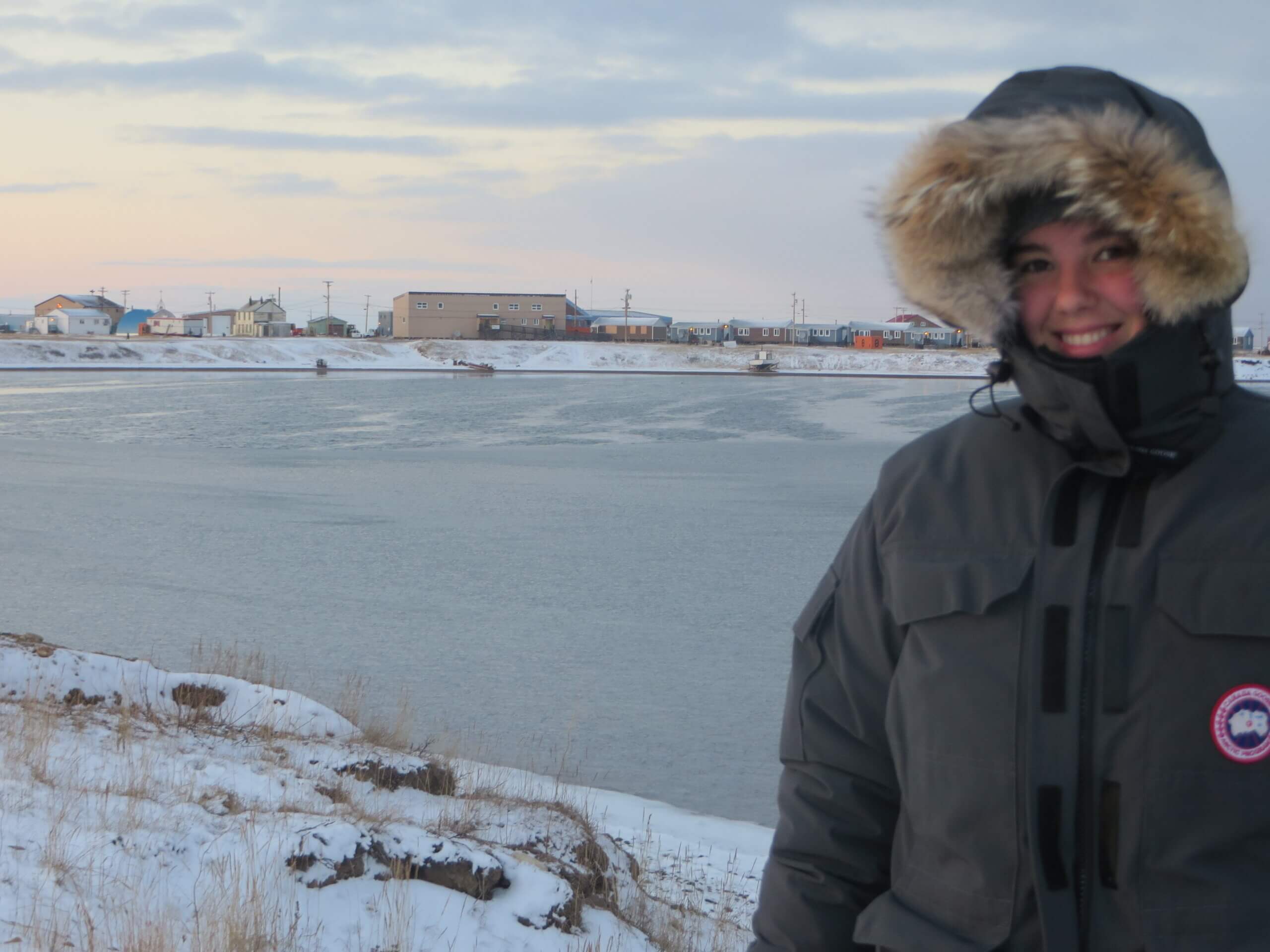
Stephanie Leithead in Paulatuk.
“It was awesome and challenging,” she said. “It beat me down, but it was also some of the most amazing moments in my life.”
After her contract ended in 2015, Leithead transitioned into traveling contract work, serving multiple northern communities. The experience deepened her understanding of what responsive, culturally grounded care could look like and sharpened her vision for the kind of practice she wanted to build.
Leithead’s travelling counselling work was so successful that over the following five years, she hired an additional four counsellors to support her overflow. Leithead had established a reputable small business, providing regular service to over 16 communities over the three territories. But all of that came to a sudden halt once COVID-19 hit and travel restrictions shut her and her travelling contractors down overnight.
“This was a huge pivoting point in my career,” Leithead said, “Everything I had built had collapsed, basically overnight. We were scrambling, trying to continue to get services to our clients without the infrastructure set up for telehealth, work around travel restrictions, it was awful.”
By 2021, she was ready to create something of her own — something lasting.
Starting Aurora Wellness Group
Leithead moved to the Yukon Territory with that vision in mind and began laying the foundation for the kind of clinic she had long imagined. The goal was clear: create a space that felt safe and welcoming, a place where care was built on connection rather than formality.
“The idea was never to look like a traditional clinic,” she said. “I really wanted it to feel less medical and more homey, safe, and inclusive. We put in couches and carts, swapped carpets for hardwood, and brought in lots of plants and art.”.
That vision became Aurora Wellness Group, which opened later that year in Whitehorse. Located in Whitehorse, Yukon Territory, Leithead in 2021 launched her own clinic, focusing primarily on residential school trauma and culturally safe mental health care. As demand grew, she hired additional providers, all committed to the same anti-oppressive practices and value-driven work as Leithead, values that strengthened during her time at Adler.
Every detail of the clinic’s design reflects that mission. From ensuring privacy, creating a wheelchair-accessible space, and being conscious of sensory accommodations, Leithead and her staff prioritized creating a safe and welcoming space.

Stephanie Leithead and her husband in front of Aurora Wellness Group.
“The longer I’ve been in the field, the more I realize how central safety is — on every level. If people feel safe in their bodies, their communities, and in the world, they’re more able to heal. That sense of safety really drove every design and policy decision,” Leithead said.
One of the most distinctive features of the Aurora model is that the clinic offers free counselling — a move that seems counterintuitive from a business standpoint but is a key part of its ethos.
“That nearly bankrupted us in the first year,” Leithead said. “I was seeing everyone for free. But we’ve found a way to make it sustainable. About 10% of our revenue now goes back into covering those sessions. We’ve applied for government support over the years, but we’ve never been successful, even though we know these services are meeting real needs that public systems aren’t.”
Redefining what a therapist looks like
Therapy wasn’t always the initial path for Leithead.
“I always felt a bit outside of the ‘traditional therapist’ image — especially as someone with ADHD. I talk a lot, I’m very expressive, and everything I feel shows up on my face. But now I realize those are my strengths,” Leithead said.
Leithead was originally drawn to working with children, specifically with ADHD and autism, thanks to her own nurturing instincts from a young age.
She worked in the school system as an educational assistant, but felt like her lack of schooling was holding her back from advancing in the field.
Pursuing a graduate degree felt like the next step — not only to further her career, but to do some meaningful school counselling work. That’s when she discovered play therapy — a method that helped carve her career path.
“It was such a powerful way to meet kids’ emotional needs in a way that behavior therapy never did,” Leithead said.
Her love of learning made Adler a natural fit. She was drawn to the University’s focus on advocacy and health equity — especially its support for LGBTQ+ communities, which also plays a central role in her clinic today.
“My career evolved organically. I never had a master plan. I just followed my interests,” she said. “I’ve always been a lifelong learner. I do more professional development than anyone I know. I’m constantly reading, taking courses, and learning new techniques. It energizes me.”
Growth and future plans
Today, almost four years after her Whitehorse clinic opened, Leithead and the Aurora Wellness Group have 18 clinicians and a total of 22 people. They have served over 1,800 clients in a town with a population of only 40,000.

Stephanie Leithead was originally drawn to working with children.
Leithead has no plans to slow down. Future goals include hiring traditional healers, launching dedicated men’s and youth groups, and starting a community-wide art campaign to destigmatize mental health. Leithead has also started taping back into her love of remote community counselling, and the Aurora Wellness Group is continuing to expand past Whitehorse and into the small, rural communities of the Yukon.
“We also have a crisis response team that goes into communities when needed. It’s a lot of activity, but it all fits together,” she said. “It’s a blend of clinical work and advocacy.”
For Leithead, advocacy and inclusion are not side projects — they’re the heart of her work.
“Adler instilled in me that counselling isn’t just about the individual — it’s about community and creating those spaces. Even though there’s a shortage of professionals, the right people keep showing up — the ones who care about advocacy, authenticity, and building a safe, inclusive space for healing,” she said. “If our communities are healthy, our people are healthy. That’s where healing starts.”
Learn more about the Master of Arts and Master of Counselling Psychology programs blend academic rigor with real-world practice, preparing students to enter the field as responsible, effective, and self-reflexive clinicians.