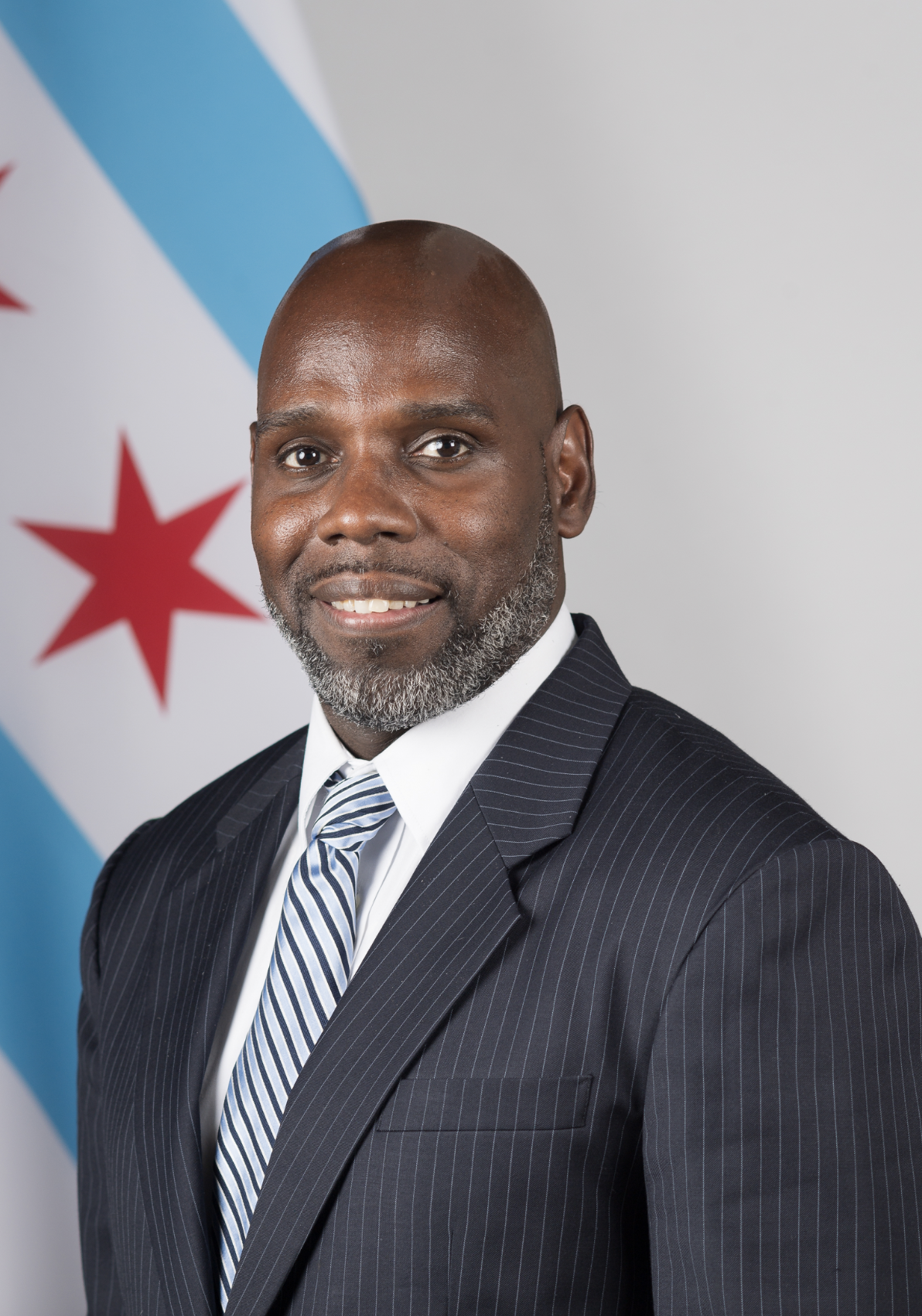
When Joseph Mapp joined Adler University as an administrative intern, he was surprised by the warm welcome he received the moment he walked through its doors in Chicago.
It was January 2020, and only weeks earlier, he had stepped out of prison after about two decades inside. That day, he said, he remembers being greeted by people who didn’t look past him or through him, but at him.
Mapp was hired by Adler’s Institute on Public Safety and Social Justice (IPSSJ), which partners with local and state governmental agencies and communities — and utilizes restorative practices and trauma-informed care — to create solutions for lasting public safety. He found his new colleagues valued his lived experience and expertise.
Five years later, Mapp’s trajectory shows how one opportunity rooted in trust, community, and restorative practice can alter the course of life. It marked the beginning of a professional journey that now positions him at the center of Chicago’s efforts to support people returning home from incarceration.
“Adler and IPSSJ were the first to take a chance with me, gave me an internship, and allowed me to discover a language that helps generate new approaches to community violence intervention and prevention,” Mapp said.
Mapp was appointed director of the city’s Office of Reentry in September 2024 by Mayor Brandon Johnson, who relaunched the Office of Reentry, which is committed to policies, programs, and initiatives that support Chicago residents returning after detention or incarceration.
“Joseph brings a wealth of experience and knowledge to lead the City’s efforts to remove barriers to reentry, empower residents to break the cycle of recidivism, and implement policies that are reflective of the needs of the population,” Mayor Johnson had said in his announcement.
Now, more than a year into the position, Mapp reflects on what it takes to build a more responsive reentry ecosystem in Chicago, why education remainscentral for people rebuilding their lives, and how Adler students and community members can engage in the initiative.
What led you to your work with the Chicago Office of Reentry?
My path to this role was personal long before it was professional. I am system-impacted, and while navigating the legal system, I was supported by people that society had locked away. Many on the inside saw something in me that I hadn’t seen yet in myself. They encouraged me to keep pursuing higher education. When I came home, I found support again, including being hired as an intern at IPSSJ. It showed me what is possible when people have a supportive network behind them, and I resolved to ensure that others like me would receive the same support. For me, this work is more than a job. It is a calling and a responsibility.
How did higher education shape your life while incarcerated and after your release?
Education was liberating for me. While serving my sentence, I participated in the Education Justice Project at the University of Illinois Urbana-Champaign, which offered a humanizing, rigorous learning experience. There were about 60 of us, and we were more than students — we helped build curriculum and programming.
That experience inspired me to write a proposal for the rest of the prison population to access similar opportunities. That proposal eventually became a peer-led program, trained and co-led by IPSSJ Executive Director Elena Quintana, Ph.D. She offered me an internship at Adler after my release where both my lived experience and my education were utilized to think through solutions to community safety. The higher education environment at Adler gave me the language to describe my lived experience without being stigmatized.
What kind of work did you do during your internship at Adler and IPSSJ?
We explored trauma-informed approaches to community violence prevention and how relationships form the foundation for any successful intervention.
As a restorative justice practitioner, I understood the power of healing relationships. The internship allowed me to combine lived experience and academic knowledge, which made me what I like to call “doubly qualified.”
Learn more about the Institute on Public Safety and Social Justice (IPSSJ) and how it creates solutions for lasting public safety
What is your vision for the Office of Reentry, and how do you define success?
My vision is simple: to build a coordinated ecosystem that sees people not as risks to be managed, but individuals to be invested in.
Success to me includes ensuring that those system-impacted have access to stable housing, meaningful and living-wage employment, dignified interactions with city systems, and a culture where returning residents are seen as returning Chicagoans. Where success is based on how a person contributes to civic life.
People often talk about crime without acknowledging that Chicago is currently enjoying the lowest overall crime rate since 1965. Much of that progress is due to community violence intervention — and 70% of that workforce is system-impacted. That’s what investment looks like, and what my office is hoping to strengthen.
What obstacles do returning residents face most often, and how are you working to address them?
The biggest barriers are housing and economic opportunities. My office is working with community partners to launch housing initiatives, leading three city departments in a fair-chance hiring cohort, and implementing Mayor Johnson’s executive order to remove onerous credential requirements and shifting the city towards skills-based hiring. We want to remove barriers that exclude people from the work they are qualified to do.
How has IPSSJ — along with its programs such as the Illinois Coalition for Higher Education in Prison(IL-CHEP) and Restorative Justice Hubs — continue to influence your work today?
These spaces and programs constantly reinforced the value of my contributions. The encouragement lets me enter any room knowing that I belong there and confidently represent millions of system-impacted people. This work humanizes people and supports healing.
How do restorative justice principles guide your leadership?
Restorative justice shifts the question from “What’s wrong with this person?” to “What was this person not given, and what do they need?”
Recidivism is often treated like a simple metric, but it assumes people had everything they needed to succeed — which is rarely the case.
Reentry should restore human dignity, not just reintegrate people. When people come home and receive support, we strengthen families, neighborhoods, and the whole city.
What misconceptions about higher education in prison do you encounter most?
People often wonder why incarcerated individuals should have access to free education while others struggle with college debt. But many of us lacked access long before incarceration.
What role do you hope Adler and its partners play in reentry moving forward?
Academia has influenced policy for decades. Adler, IPSSJ, IL-CHEP should continue offering humanizing, high-quality education—and continue expanding access.
I’m deeply appreciative of Adler because I never felt like a token while working there. I met with the provost, faculty, staff — and they truly cared. I hope every new Adler student, in Chicago, Vancouver, and worldwide, appreciates the work IPSSJ is doing.
What message would you share with Adler students interested in getting involved? Where can they start?
Move past the stigma. Most incarcerated people aren’t “bad.” Many struggled with mental health, substance use, or survival in the absence of resources. Invest in people by seeing them as contributors. It’s important to remember that one in two Americans has a close family member or friend who is system-impacted.
I know Adler works closely with many community-based organizations that support our many marginalized residents. I’d encourage students who want to know how to get started by choosing practicums and internships at these programs.
I know Alfred Adler was the first community psychologist who emphasized the role of community, prevention, and social context in shaping health and well-being. He helped introduce public education as a tool for improving community life. I can say that those concepts are very much in line with mine. Anything meant to benefit us must begin with us. We can create better communities where everyone feels that they’re part of a solution.