
When Tamara Hubbard’s three-year-old son was diagnosed with a peanut allergy, she found plenty of medical guidance, but nothing to help her family cope with the anxiety.
“It was completely overwhelming,” said Hubbard, MA ’04. “We’d never had food allergies in our family.”
The answers she needed didn’t exist. So, Hubbard created them.
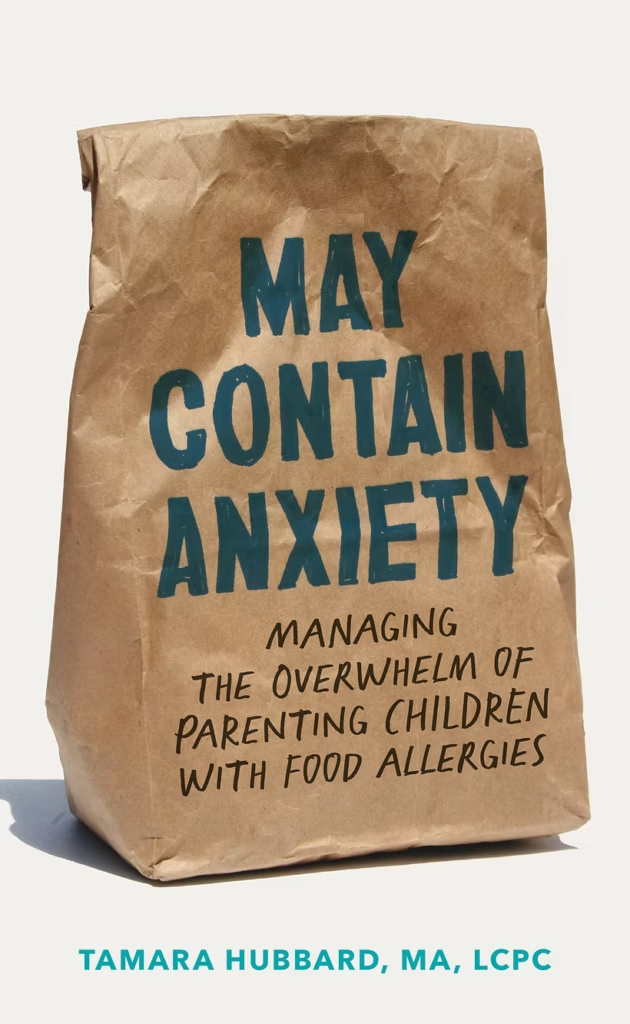
Today, Hubbard’s work has transformed support for food allergy families nationwide. Her book, “May Contain Anxiety: Managing the Overwhelm of Parenting Children with Food Allergies” blends professional counseling insight with lived experience, offering families guidance not just on safety, but on the anxiety, grief, and constant anxiety that often accompany food allergies. It hit No. 1 on Amazon’s new releases for food allergies and children’s health within weeks of its September 2025 publication, met with tons of reviews from thankful parents and caretakers.
A natural fit with Adlerian thinking
“I found all of Adler’s theories and principles to make total sense to me,” Hubbard said.
Hubbard came to Adler after teaching elementary school, drawn by a question that kept nagging at her: Why do children behave the way they do? She found her answer in the Master of Arts in Couple and Family Therapy program.
“I’m a systems thinker by nature, so the couple and family therapy program made sense. Even when I’m working individually with people, I want to understand their systems. I was hoping to gain a better grasp of these systems at Adler,” she said.
That systems-based perspective of looking at the whole family, not just the individual, became essential when her son was diagnosed. Hubbard then attended a Center for Food Allergy and Asthma Research (CFAAR) conference in Chicago, hoping to find support. Instead, she found a glaring gap: nothing addressed the emotional toll — the constant vigilance, the social isolation, the anticipatory anxiety that consumed parents like her.
“It became very clear to me that there really weren’t resources out there to help families with the emotional and psychosocial aspects of living with food allergies,” Hubbard said.
From personal experience to professional mission
Hubbard began applying her clinical training to understand not just her son’s medical needs, but how his allergy affected family dynamics, sibling relationships, social belonging, and her own mental health as a parent.
“Once I got my footing as a parent, my therapist parts kicked in,” Hubbard said. “I thought, ‘I bet there are people out there who need this kind of support too.’ I never would have ended up in this work if it wasn’t for my son’s diagnosis.”
In 2018, she launched Food Allergy Counselor, initially as a blog sharing insights from both her clinical training and lived experience. The response was immediate. Therapy requests poured in from across the country, far more than one therapist could handle.
Due to that demand, Hubbard expanded her reach. If she couldn’t help everyone directly, she could train others. She created the Academy of Food Allergy Counseling, educating therapists nationwide on the unique psychosocial needs of food allergy families. The academy is now certified by the National Board of Certified Counselors.
“The directory gets cited all the time at national conferences and educational seminars,” Hubbard said. “We’re also building education for therapists and are now certified by the National Board of Certified Counselors. Our goal is to help more clinicians understand what families living with food allergies actually need.”
Creating resources that didn’t exist
When a friend of Hubbard’s approached her about writing a book in 2021, Hubbard saw the opportunity to consolidate years of research, clinical insight, and practical tools into a single accessible resource for overwhelmed parents.
“All of the work I’ve done has been about creating resources that didn’t exist when I needed them,” Hubbard said. “This book is part of that.”
“May Contain Anxiety” reflects her Adlerian training throughout, taking a holistic approach to food allergies, examining family systems rather than isolated individuals, and providing not just insight but actionable strategies for change. The book addresses the mental load parents carry, helps families process grief, and offers frameworks for creating more inclusive communities.
Today, her son is a thriving 16-year-old. The family has learned to navigate his allergy with confidence rather than fear — a transformation Hubbard now helps other families achieve through her writing, her Academy, and her continued advocacy for integrating mental health into food allergy care.
The foundation that made it all possible
Looking back, Hubbard sees a direct line from her Adler education to every aspect of her current work, from recognizing systemic gaps in care to building sustainable solutions that serve entire communities.
“I’m grateful to Adler for giving me that grounding that led me to be able to apply it to work in this niche sector and help me be able to make a difference in my community,” Hubbard said.