Maiya Gillespie still remembers the long conversations across a table at a youth drop-in center in Victoria, British Columbia — sharing coffee, listening to young people’s stories, and helping meet everyday needs like food, clothing, and laundry.
Long before beginning her doctoral studies at Adler University, Gillespie volunteered at the center while completing her undergraduate degree. What began as volunteer work soon became something more significant when the organization hired her as a staff member.
Those small moments of connection shaped how Gillespie began to think about mental health care, and ultimately, the direction of her career.
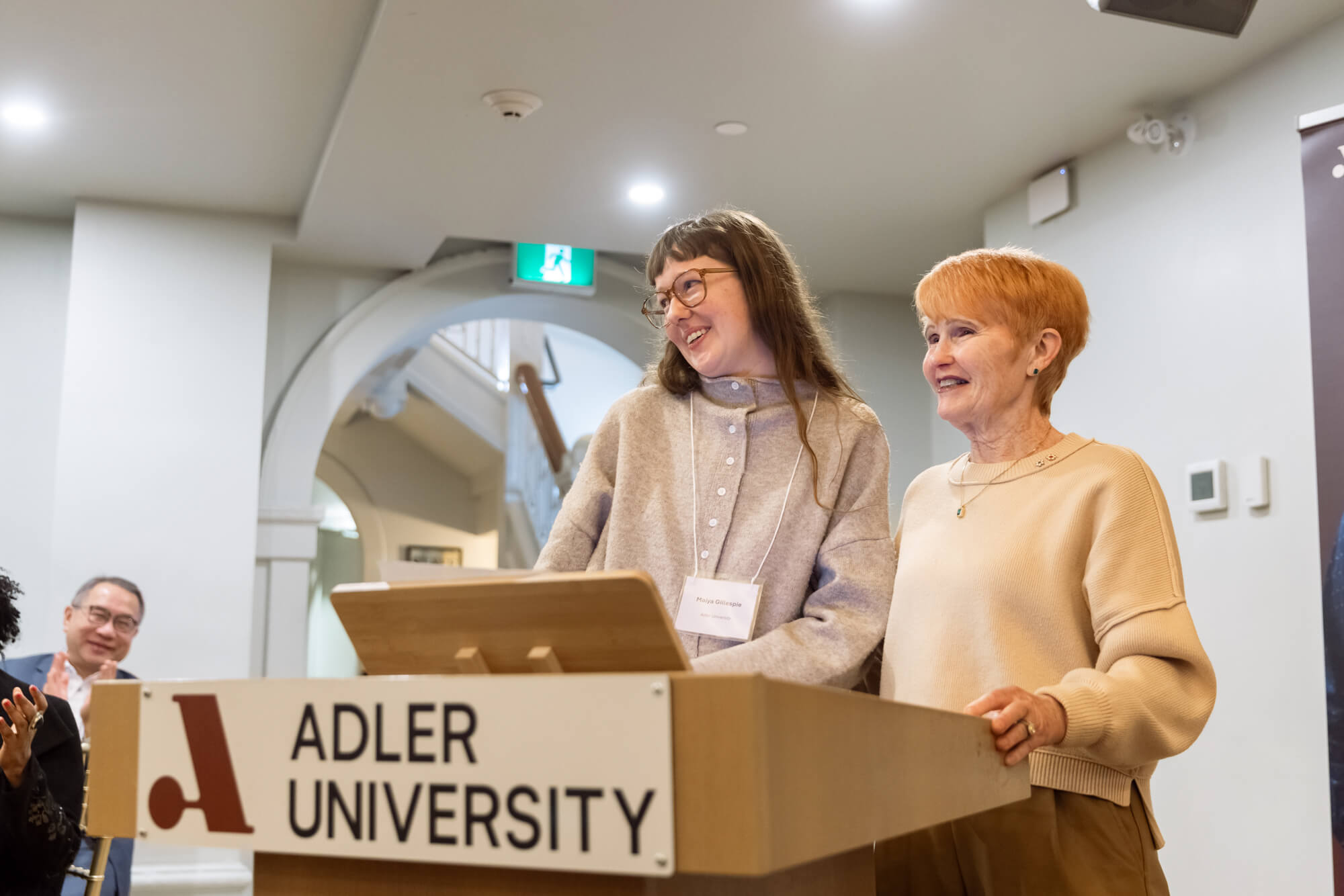
Now a doctoral student in the clinical psychology program at Adler, Gillespie has been named this year’s recipient of the Joy MacPhail Leadership Scholarship. The award was presented by Joy MacPhail during Adler’s annual Women’s Leadership Showcase in Vancouver on March 17 and is given each year to a student who demonstrates leadership and commitment to the community. The event also featured a conversation on leadership and the experience of breaking new ground as “firsts,” with President Lisa Coleman, Ph.D., Erin Seeley, CEO of YWCA B.C., and Monica McAlduff, CEO of the First Nations Health Authority.
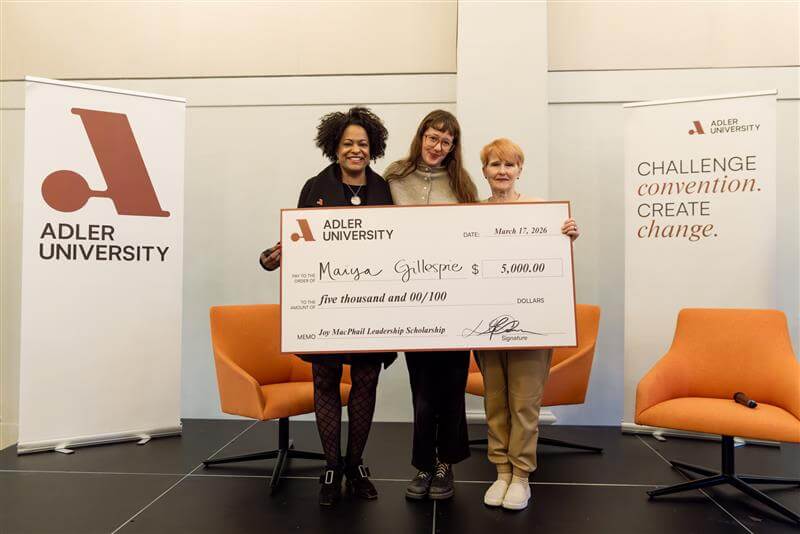
“Maiya is a very strong student,” said Manal Guirguis-Younger, Ph.D., program director of the Doctor of Psychology (Psy.D.) in Clinical Psychology program in Vancouver. “She has a strong academic record and is a solid clinical trainee. Maiya is very professional and well respected. We feel she is very deserving.”
For Gillespie, the recognition arrives at a meaningful moment — both personally and professionally.
“This will relieve some of the financial strain I’ve been navigating while finishing the program,” she said.
A foundation in care
Gillespie grew up in Victoria and attended the University of Victoria, where she majored in psychology and minored in social justice studies. During her time there, she published an undergraduate thesis examining the accessibility of harm-reduction services for street-involved youth, work that helped clarify the direction she wanted her career to take.
The work deepened her interest in community-based mental health and reinforced her decision to continue her education at Adler.
“It just felt like the most aligned place for me,” she said.
Like many graduate students, Gillespie faced the reality of financing an advanced degree. Ultimately, she decided to take the leap and pursue the program despite the uncertainty.
Gillespie’s undergraduate thesis later focused on the accessibility of harm-reduction services for street-involved youth, an issue she continues to study today.
Building expertise at Adler
At Adler, Gillespie has continued to center her training around community mental health.
Her first-year Social Justice Practicum took place at Foundry Youth Clinic, a free resource designed to support young people navigating mental health and substance use challenges. Later, she gained experience conducting psychological assessments for children and youth in a structured clinical setting.
While that work built important skills, it also confirmed something Gillespie already suspected.
“Being in community mental health settings is really where I feel most drawn,” she said.
Today, Gillespie is completing her third-year practicum at a residential substance use treatment center for women. Many of the residents live there with their babies while receiving treatment, allowing them to remain together while accessing support.
The experience has reinforced her commitment to serving vulnerable populations, including women navigating addiction, mental health challenges, and parenting responsibilities at the same time.
“Women often have additional safety concerns and responsibilities,” Gillespie said. “They’re trying to care for their children while also addressing their own mental health and substance use struggles.”
Gillespie credits much of her growth at Adler to mentorship from faculty members who have helped shape her approach to clinical work and research.
She works closely with Janelle Kwee, Ph.D., and Derrick Klaassen, Ph.D., through Adler’s existential psychotherapy research lab. Dr. Klaassen will supervise her doctoral dissertation, with Dr. Kwee serving as co-chair.
“I really look up to both of them and the work that they do,” Gillespie said. “When I started learning from them, I remember thinking they were part of the reason I was meant to be at Adler.”
Her dissertation will focus on the experiences of psychotherapy among street-involved youth — an extension of the work she began years earlier in community drop-in centers.
“I want to contribute to understanding how best to serve this population,” she said. “There’s so much more wraparound care that needs to be built for youth navigating mental health and substance use challenges.”
While Gillespie is committed to becoming a skilled clinician, she also sees the role of psychologists extending beyond individual therapy. In communities like Vancouver, where a toxic drug crisis continues to impact vulnerable populations, Gillispie believes psychologists can play a role in shaping broader systems of care and hopes her research can push for policy change.
“I want to advocate for services that are actually accessible,” she said. “Mental health care shouldn’t only be available to people who can afford high private-practice fees.”
The power of showing up
Reflecting on her early experiences in youth drop-in centers, Gillespie says that often, young people simply seemed surprised that someone was willing to take the time to hear them.
“Sometimes they would ask why I cared,” she said.
Those moments reaffirmed her decision to pursue advanced training.
“They made me want to increase my capacity to be supportive, to be even more helpful and better trained,” she said.
With the support of the Joy MacPhail Scholarship and her continued work at Adler, Gillespie is now building that capacity — one relationship, and one community, at a time.